
How cities can lead the reuse revolution
Reuseable packaging systems often fail at small-scale, which is why many of the most exciting projects in this area
Reuseable packaging systems often fail at small-scale, which is why many of the most exciting projects in this area

The National Wealth Fund is investing £19.6 million (€23,408,476) into Pulpex’s new manufacturing facility, which is
EUROPEN, the Circular Economy Network, Konfederacja Lewiatan, and the Croatian Business Council for Sustainable Development have founded Recycle Now, a

Reuseable packaging systems often fail at small-scale, which is why many of the most exciting projects in this area are currently taking place in highly dense urban areas.
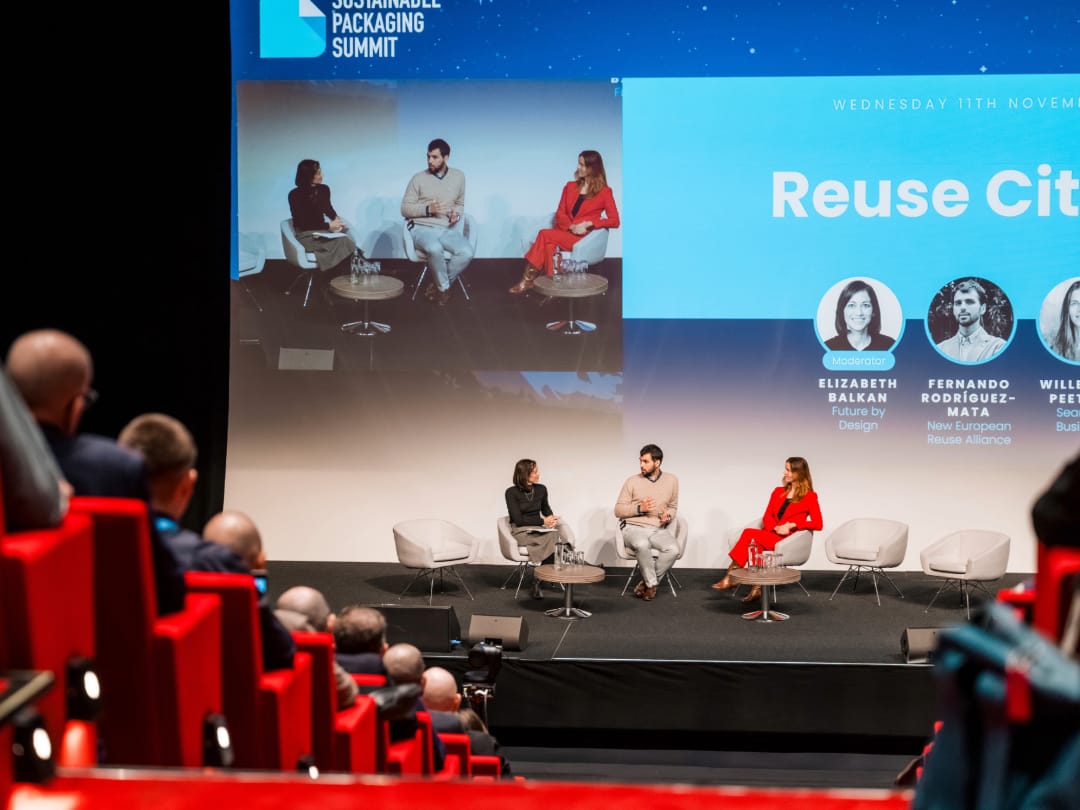
In this article that follows on from their session on this topic at the 2026 Sustainable Packaging Summit, Willemijn Peeters, founder and CEO of Searious Business, Fernando Rodríguez-Mata, director general at New European Reuse Alliance, and Elizabeth Balkan, founder and principal of Future by Design, identify the most important learnings from city-wide reuse projects across the world.
Reuse sure has come a long way. Years of pilots have shown what works and what doesn’t. We know how to design packaging for repeated use, track it digitally and incentivise consumers to return it. But scaling beyond individual schemes remains a bottleneck. We have proven again and again that reuse adds up once enough volume can be reached.
However, for individual brands, retailers, and food operators both big and small, the math on proprietary reuse loops often does not add up. Running a solo reuse operation means building expensive new infrastructure from scratch while trying to compete with a single-use system that has had decades to optimise. Could shared systems spread those costs, making reuse commercially attractive and finally cure our pilotitis?
Cities change the maths
Cities offer the density and volume that make shared reuse systems work. Restaurants, coffee stands, and supermarkets generate packaging that flows through the same streets. Connecting them compounds the volume, meaning infrastructure can be used more intensively, improving the economics and making investment more attractive. It even makes reuse more convenient because more recognisability and more return points mean it fits within people’s daily routines. It becomes normal.
Searious Business has been exploring this opportunity with the City of Amsterdam, looking at how shared urban infrastructure can connect businesses and consumers through practical return systems. By pooling resources, the model could make reuse accessible to smaller independent outlets that would otherwise struggle to afford their own systems. Aarhus and Copenhagen have introduced citywide systems for takeaway packaging, while initiatives in Hilo, Ottawa and Lisbon are exploring how reuse can be harmonised and scaled.
There are lessons, too, from reusable transport packaging. RePLHA compared company-owned systems with a pooled model for white goods and found that pooling could deliver savings of almost 30%. Sharing assets improves utilisation, reduces inventory, and makes reverse logistics far more efficient. The principle is the same for B2C - the faster an item returns for its next use, the fewer are needed to serve the same market. Research from the European BUDDIE-PACK project reinforces this. Return rates, packaging lifetime, retention times, cleaning and transport costs, and collaboration all influence reuse economics.
Share the infrastructure, not the competition
Working alongside competitors can feel risky, as businesses worry about losing control over how they operate. Yet sharing the system ensures no single operator is stuck paying extra for sustainability, allowing smaller businesses to finally afford to join in. Companies can still compete where it actually matters: on their product, their service, and the experience they offer, while sharing visible civic pride in keeping their city’s streets clean.
Scale alone will not resolve every challenge because costs and benefits are not always distributed equally. For example, a municipality might save on litter collection while a retailer takes on additional handling costs. A washing operator may need guaranteed volumes before investing, while businesses want capacity in place before they commit. A successful citywide system must establish who invests, who benefits and how value is shared. This is where policy and financing become essential.
Policy can stack the deck
Supportive policy creates demand and a clearer route to profitability, giving companies confidence to invest. A growing body of evidence, such as the research compiled in the New ERA repository, already demonstrates the environmental, operational, and economic viability of reuse. Turning those findings into scale requires predictable rules: binding measures, clear implementation and consistent enforcement.
Public authorities have several tools:
Timing matters. Policy should support a phased approach: bring demand together, secure purchasing commitments and allocate infrastructure funding against realistic volume forecasts. Time-limited guarantees can bridge initial investment, with funding released as capacity and participation grow. Shared infrastructure should remain open to different operators and business models.
The aim is to make reuse investable through predictable demand, proportionate risk-sharing and a clear timetable, while preserving competition on service, efficiency and innovation.
Financing on the journey to scale
Cities are critical to planning and implementing reuse systems, but effective action needs support on several fronts:
● Institutional coordination: Reuse spans municipal agencies and requires commitment at the highest political level. Networks can help cities learn from peers nationally and internationally.
● Infrastructure investment: New systems may need substantial upfront funding. Cities should consider public-private partnerships and performance-based tendering. For example, Hilo, Hawaiʻi recently launched the Hoʻi returnable dish program, backed by $3.9 million in combined federal grants and private funding to build infrastructure from the ground up.
● Communication and shared strategies: EPR efforts are still nascent in many countries, and experience shows they can face opposition. Cities need clear messaging, knowledge exchange and community engagement to build political support and guide policy.
● EU funding instruments and blending facilities: Tapping into established European funding streams such as the LIFE, Horizon Europe, or the European Circular Bioeconomy Fund (ECBF) can provide crucial early-stage grants and risk-sharing capital. Aligning local municipal projects with broader EU green transition targets helps de-risk private investments and accelerates the transition from regional pilots to cross-border standardisation.
First-mover cities can demonstrate what works and help others follow. Connecting the people behind these initiatives accelerates policy development and helps solve common challenges.
Business in the city
Let's build a European reuse pioneer city. Amsterdam, Brussels or Paris could bring brands, retailers, reuse operators and the municipality together around one ambition, make reuse an easy everyday choice and a compelling business proposition.
Start by mapping the city's packaging flows, existing providers and sources of demand, then identify where collaboration can deliver the greatest value. Brands should help shape this market, not simply sign up to another pilot. Compete on your products, sure, but share the packaging that makes reuse work. The goal is a system where competing businesses thrive on shared foundations, and a model that can be replicated in other cities.
We know how individual reuse systems work. Now we need to connect them. Who will be the leader of Europe's reuse revolution?
If you liked this story, you might also enjoy:
The ultimate guide to global packaging sustainability regulation in 2026
PPWR timeline: the key dates to know

Foreign material contamination is far from an exceptional problem in food production: according to the 2026 Foreign Material Contamination in

As the Packaging and Packaging Waste Regulation unfolds, businesses must adapt accordingly. In this edition of our ‘In Conversation With…

In this edition of The Spotlight, Markem-Imaje examines how supply chains have evolved, and how Print and Apply (P&

In this edition of the Spotlight, the experts from UPM discuss what manufacturers have to bear in mind when choosing

Solidus is introducing Futurline Heat&Eat, a new trademark for its range of fibre-based modified atmosphere packaging (MAP)

Label and packaging printers are under increasing pressure to produce more jobs, in shorter runs, with tighter margins and less

In our latest Spotlight, Arnaud Brunet, Senior Director Portfolio and Sustainability at CRYOVAC®, looks at why food packaging has to

As PET bottles incorporate more recycled content, become lighter and adopt label constructions, the adhesive securing the label must perform

The National Wealth Fund is investing £19.6 million (€23,408,476) into Pulpex’s new manufacturing facility, which is

EUROPEN, the Circular Economy Network, Konfederacja Lewiatan, and the Croatian Business Council for Sustainable Development have founded Recycle Now, a

Innovia Films is a finalist in this year’s Sustainability Awards with its ‘world first’ food safe recycled polypropylene (rPP)

GPA Global has created a fully recyclable paper-based design for Midleton Very Rare’s Irish whiskey, featuring a double-